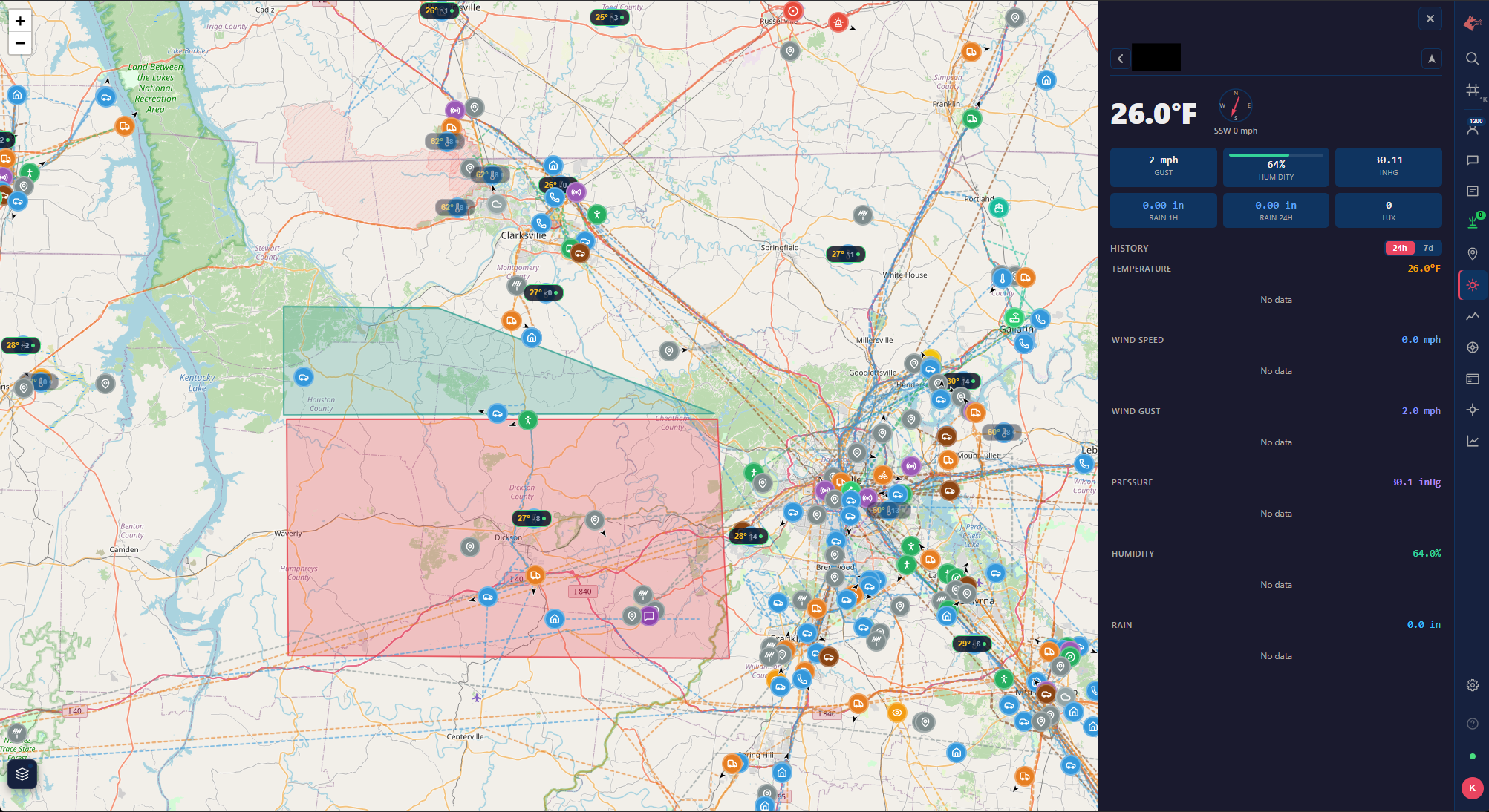
A beautiful, web-based APRS client designed for individuals and teams. Real-time maps, multi-user collaboration, RF integration, and emergency communications tools — all in a single binary.
The APRS community has built incredible tools over decades. Nymeria brings that same spirit into a modern, web-native package.
A responsive, real-time interface that runs in any browser. Desktop panel layout, mobile bottom sheet — one codebase, every screen size.
Multiple operators share one station with role-based access. Message claiming, activity logs, and real-time sync keep everyone coordinated.
Download one file, run it. No Java, no package managers, no runtime dependencies. Go + embedded SvelteKit — it just works.
APRS-IS, Direwolf KISS TCP, and hardware serial TNCs. Run dual transports simultaneously with automatic cross-transport deduplication.
Stations appear in real time with track history, and smooth animations. Search by callsign, click to inspect, and fly across the map with a single tap.
Nymeria is the first APRS client built from the ground up for shared operation. Four role tiers control who can observe, annotate, transmit, or configure — so your whole team can work from a single station.
Nymeria compiles the entire application — backend, frontend, and all assets — into a single executable. No Java runtime. No npm. No docker required (but supported). Just copy the binary and go.
Purpose-built tools for ARES, RACES, and community emergency response. Nymeria helps your team maintain situational awareness and coordinate operations when the pressure is on.
Full net lifecycle management with operator roster, check-ins, status tracking, roll calls, and NCS transfers. Smart sorting surfaces who needs attention.
Automatically generate ICS-309 forms from APRS message traffic. Filter by time range or net session. Print to PDF or export as CSV.
Create missions with priority levels, assign operators, track status. Bidirectional linking between missions and map annotations keeps the picture clear.
Points, lines, and areas with 8 categories, priority levels, and 15 built-in templates for events, SAR, and disaster response. Promote to RF objects with one click.
Map APRS callsigns to friendly identifiers like "SHELTER-1" or "SAG-NORTH". Pre-configure in YAML, assign in the UI, or detect from APRS TACTICAL messages.
Every action timestamped and attributed. Filter by event type, operator, or time range. Full audit trail with CSV export for after-action reports.
Dedicated weather station panel with temperature, wind, rain, pressure, humidity, and more. Historical charts and configurable alert thresholds.
Automatic PARM/UNIT/EQNS metadata parsing with multi-series time charts. Human-readable channel labels and coefficient-based value conversion.
Full send/receive with auto-acknowledgment, retry with exponential backoff, conversation threading, and a built-in 67-character counter.
Parse DF packets, visualize bearing lines on the map, compute multi-station triangulation with confidence spread, and fly to the estimated target.
Raw protocol view with real-time packet stream, type/source filtering, pause/resume, and expandable detail for each packet's full TNC2 payload.
Build APRS-IS server-side filters with a visual editor. Range, prefix, symbol, and area rules with a mini-map preview. Toggle between visual and raw modes.
Create, retransmit, and kill APRS objects and items. Promote map annotations to RF-transmitted objects with proper APRS symbol mapping.
Create and view APRS bulletins (BLN0-BLN9) with automatic number sequencing, deduplication, and real-time display.
Fixed-interval and manual beacon trigger. Configurable comment, automatic suppression when no transports are connected, and smart beaconing framework.
APRS has been connecting amateur radio operators for over 30 years, thanks to the vision of Bob Bruninga, WB4APR (SK), and the incredible community of developers and operators who have built and maintained the ecosystem.
Tools like YAAC, Xastir, APRSISCE/32, APRSdroid, PinPoint APRS, Direwolf, and many others have made APRS accessible to thousands of hams worldwide. Nymeria is proud to be part of this tradition — we're just adding a new option to the toolbox with a focus on modern web technology and multi-user collaboration.
73 to all the developers and operators keeping APRS alive.
Nymeria is designed to get out of your way. Minimal configuration, sensible defaults, and a setup wizard that guides you through the rest.
Grab a release binary for your platform, or build from source with Go 1.24+ and Node.js.
git clone https://github.com/longjos/Nymeria
cd Nymeria && make build
Create a minimal YAML config with your callsign. The setup wizard handles the rest — position, transports, and filters.
callsign: "W4ABC"
ssid: 9
Start the binary and open your browser. Nymeria serves itself — no separate web server needed.
./nymeria --listen :9090
Nymeria is free, open source, and built with care by hams for hams. Join us on GitHub.